
Japanese Patent Case Summary: 2024 (Gyo-ke) No. 10039 – Intellectual Property High Court (December 25, 2024)
“Bag with Emboss”
Overview:
This case is one in which the trial decision in an appeal trial against an examiner’s decision of refusal that stated “the request for this trial is not allowable” was upheld.
▶Summary of Judgment and Link to Full Text (Japanese)
Main Issues:
The main issue is whether there is any factor that would hinder configuring the “matte region” in Cited Invention 1 as multiple stripe-like rows of protrusions and recesses.
Summary:
The trial decision held that, in Invention 1 of the subject application, what represents a logo mark without using ink is the “unit emboss (3),” and that “the bag (1) has, on a part or the entirety thereof, one unit emboss (3) or a continuous series of unit embosses (3), and the unit emboss (3) includes multiple rows of protrusions and recesses”; whereas, in the bag of Cited Invention 1, what represents a logo mark without using ink is the “matte region,” and that “the hand-carry bag 8 has, on its surface, a matte region, and the matte region is provided with minute unevenness,” and thus they differ in these respects; but it determined that making it such that a logo mark or the like is represented on “a part or the entirety” of the bag is a matter of design that a person skilled in the art could appropriately carry out.
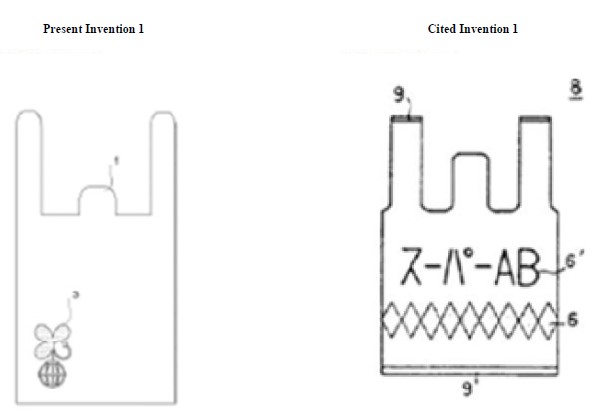
In response, the Plaintiff argued that, in Cited Invention 1, the “matte region” is an essential problem-solving principle, and that there are hindering factors against configuring it as multiple stripe-like rows of protrusions and recesses.
The Court held that both the “matte region” of Cited Invention 1 and the “multiple rows of waves” described in Cited Document 2 share the common action and function of expressing a pattern by forming minute unevenness on the film surface without providing a printing process; and that even if, in place of expressing a pattern by the “matte region” of Cited Invention 1, the pattern expression by the “multiple rows of waves” described in Cited Document 2 were applied, the problem to be solved in Cited Invention 1 (“a simple pattern expression method that can be incorporated into ordinary film-forming, bag-making, or bag-making/filling processes without specially providing a printing process”) would still be solved. Accordingly, it cannot be said that the “matte region” of Cited Invention 1 is an indispensable problem-solving principle, and it cannot be said that there is any hindering factor whereby combining the teachings described in Cited Document 2 with Cited Invention 1 would negate the problem-solving principle of Cited Invention 1.
Comments:
Furthermore, the Plaintiff argued that the disclosures of Cited Document 2 involve transferring the surface shape to the film by circumferentially wrapping a metal wire around a press roll, and that, because one cannot recognize the dense parallel arrangement of the metal wire only at the logo-mark portion, there is no motivation to combine. The Court, however, held that, in the disclosures of Cited Document 2, if one configures the cylindrical roll surface as a localized pattern such as a logo mark, provides the other portions as notched sections, and closely winds piano wire around it, a waveform corresponding to a localized pattern such as a logo mark will be formed in the film; and that this is a matter of design that a person skilled in the art could appropriately select according to the visibility and the like required of the pattern. It therefore did not adopt the Plaintiff’s argument.
Hiroshi ABE