
Japanese Patent Case Summary: 2025 (Gyo-Ke) No. 10065 – Intellectual Property High Court (April 22, 2026)
“Treatment for Diabetes in Patients with Insufficient Glycemic Control Despite Therapy with Oral or Non-oral Antidiabetic Drug”
Overview:
The patent at issue relates to a pharmaceutical composition containing a DPP-4 inhibitor for treating and/or preventing type 2 diabetes. Regarding the trial decision of the Japan Patent Office (JPO) rejecting a request for patent invalidation, the Court upheld the trial decision, dismissing the Plaintiff’s arguments regarding violations of the enablement and support requirements (it also ruled that the framework for determining these requirements should not incorporate determinations of novelty and inventive step).
▶Summary of Judgement and Link to Full Text (Japanese)
Main Issue:
The impact of the presence or absence of pharmacological data on the enablement and support requirements (While the detailed description of the invention contained pharmacological data from oral administration to type 2 diabetic mice, it did not describe pharmacological test results confirmed with the specific patients, dosage and administration, and combination administration specified in the present invention.)
Whether the determination of the enablement and support requirements should require “supporting descriptions sufficient for a person skilled in the art to understand that an invention possessing novelty and inventive step and having superior attributes or effects compared to the prior art can be implemented”, and “that the present invention is supported as having superior attributes, actions or effects compared to the prior art.”
Summary:
“Regarding Present Invention 1, the present specification describes, as detailed in …, that:
(i) DPP-4 inhibitors are beneficial drugs for treating diabetes by preventing physiologically active peptides such as GLP-1 from being degraded by DPP-4, which would otherwise lower their plasma concentration…;
(ii) In diabetes, different metabolic dysfunctions often occur simultaneously, and thus multiple anti-diabetic drugs having different active ingredients are frequently administered in combination…;
(iii) Depending on the type of said dysfunction occurring in a patient, administering a DPP-4 inhibitor in combination with a conventional anti-diabetic drug can be expected to improve treatment outcomes, and an alpha-glucosidase blocker is a candidate for this combined anti-diabetic drug…; and
(iv) The present compound is a DPP-4 inhibitor, and in addition to its DPP-4 inhibitory effect continuing for 24 hours even at a low dose of 5 mg administered once daily, it is excreted as-is primarily via bile, which can benefit patient populations with a high prevalence of renal insufficiency and diabetic nephropathy…”
“As of the filing date of the present application, … both DPP-4 inhibitors and alpha-glucosidase blockers were oral anti-diabetic drugs for type 2 diabetes. The mechanism of action of the former is to enhance the activity of incretin glucagon-like peptide-1 (GLP-1) to promote glucose-dependent insulin secretion, whereas the mechanism of action of the latter is to inhibit intestinal carbohydrate absorption, meaning the two have different mechanisms of action. … In the field of therapeutic agents for type 2 diabetes, combination therapy combining oral anti-diabetic drugs with different mechanisms of action was widely practiced. … Since no circumstances can be observed suggesting that significant side effects or adverse events would occur when administered in combination, a person skilled in the art who has access to the present specification would be able to understand, based on the description in the present specification and the common general technical knowledge as of the filing date of the present application, that by using the present compound (or a pharmaceutically acceptable salt thereof), which is a DPP-4 inhibitor, in combination with an alpha-glucosidase blocker having a different mechanism of action, and administering it to patients for whom treatment with the alpha-glucosidase blocker has become secondarily ineffective (note by author: patients for whom efficacy has diminished or become insufficient), the actions of both agents complement each other, thereby improving the therapeutic effect against type 2 diabetes compared to when each is used alone.”
“The enablement requirement (Patent Act Article 36(4)(i)) is understood to be prescribed as a requirement for the description of the detailed description of the invention because, if the configuration, etc., of the invention is not described in the detailed description of the invention to such an extent that a person skilled in the art can easily carry out the invention, the invention is not disclosed to the public, thereby lacking the premise for granting exclusive and proprietary rights to the inventor. In contrast, novelty and inventive step (Patent Act Article 29(1) & (2)) are prescribed as requirements for patentability in order to exclude publicly known inventions or inventions that a person skilled in the art could have easily conceived from publicly known techniques from being eligible for patent grant, so as not to generate exclusive and proprietary rights for such inventions. Accordingly, the determination of whether the enablement requirement is satisfied should be made from the aforementioned perspective, and the framework for this determination should not incorporate determinations of novelty and inventive step.”
“The support requirement (Patent Act Article 36(6)(i)) is prescribed as a requirement for the description of the scope of claims in order to prevent the generation of exclusive and proprietary rights for an undisclosed invention, which would occur if an invention not described in the detailed description of the invention were described in the scope of claims. In contrast, novelty and inventive step (Patent Act Article 29(1) & (2)) are … prescribed as requirements for patentability. Accordingly, the determination of whether the support requirement is satisfied should be made from the aforementioned perspective, and the framework for this determination should not incorporate determinations of novelty and inventive step.”
Comments:
In this ruling, the Court presented the following criteria for determination: “Generally, in inventions for pharmaceutical use…in order to satisfy the enablement requirement, it is necessary to describe in the specification pharmacological data regarding the fact that the substance can be used for said use, or matters that can be equated therewith, so that a person skilled in the art can understand, in light of the common general technical knowledge at the time of filing, that said substance can be used as a medicine for said use.” This judgement is noteworthy in that, based on this criteria, the Court pointed out that both pharmaceutical composition components were oral anti-diabetic drugs for type 2 diabetes with different mechanisms of action, that combination therapy was widely practiced in the field of therapeutic agents for type 2 diabetes, and found that there are no circumstances suggesting the occurrence of significant side effects or adverse events due to the combination of both pharmaceutical composition components. The Court then ruled that a person skilled in the art who has access to the present specification would be able to understand, based on the description in the present specification and the common general technical knowledge as of the filing date of the present application, the complementary action of both agents through combination and the improvement of the therapeutic effect against type 2 diabetes, and thus could understand that the substance can be used as a medicine for said use (ruling that the lack of description of pharmacological data does not immediately mean that the enablement requirement is not satisfied).
In addition, the enablement requirement and the support requirement are prescribed as requirements for the description of the detailed description of the invention and the scope of claims, respectively. The ruling that the framework for determining whether these requirements are satisfied should not incorporate determinations of novelty and inventive step share the same import as the Grand Panel decision on Pyrimidine Derivatives. (As a related judicial precedent, in the Rice Milk Case (2017 (Gyo-Ke) No. 10129), an opposition decision was rescinded because it had made a judgement on the support requirement by identifying a problem different from the problem described in the detailed description of the invention under the guise of considering the state of the art at the time of filing.)
Patent Claim 1
A pharmaceutical composition comprising a DPP-4 inhibitor for use in the treatment and/or prevention of type 2 diabetes in patients with insufficient glycemic control despite a therapy with a conventional oral anti-diabetic drug, wherein
the conventional oral anti-diabetic drug is an alpha-glucosidase blocker,
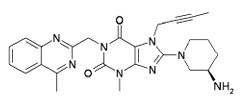
the DPP-4 inhibitor is a compound of the following formula or a pharmaceutically acceptable salt thereof,
the pharmaceutical composition is administered in combination with the conventional anti-diabetic drug, and
the DPP-4 inhibitor is administered orally at a daily dose of 5 mg:
Formula (I)
Satoki SERA