
Japanese Patent Case Summary: 2025 (Gyo-Ke) No. 10069 – Intellectual Property High Court (April 23, 2026)
“Roll Product Package”
Overview:
This case is an example in which the court upheld an invalidation trial decision stating that “the patent regarding the inventions according to claims 1, 3, 4, 6 and 7 of JP 6590596 shall be invalidated”.
▶Summary of Judgement and Link to Full Text (Japanese)
Main Issue:
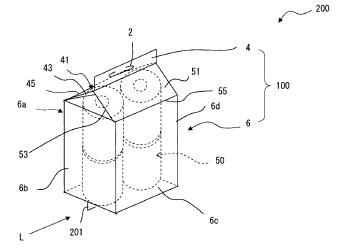
The main issue was whether it would have been easy for a person skilled in the art to arrive at the configuration of Subject Invention 1, which specifies: “wound 2-ply embossed sheets of sanitary tissue paper”; being “packaged in said packaging bag with two tiers arranged in a row and stacked along the upright axial direction”; and having “a winding length of 63 to 103 m, a mass of one roll product including a core of 200 to 370 g, and a ratio of (mass of the four roll products in said packaging bag) / (basis weight of said film) of 25 to 80 [g/(g/m2)]” (Difference 1).
Summary:
Concerning the “roll product”, the JPO trial decision determined that the skilled person should have appropriately considered adopting a 2-ply sheet, increasing the winding length and reducing the number of rolls per package, in view of the technical common knowledge; therefore, there was sufficient motivation to apply the matters described in Plaintiff’s Exhibit 2 (which leads toward increasing the winding length of a 2-ply sheet and reducing the number of rolls per package) to the invention described in Plaintiff’s Exhibit 1, and the skilled person could have easily arrived at applying the matters described in Plaintiff’s Exhibits 2 to the Plaintiff’s Exhibit 1 invention to arrive at the configuration of Invention 1 relating to Difference 1.
In response to this decision, the plaintiff argued that there is a difference in packaging form, namely gusset packaging versus caramel packaging, between the Plaintiff’s Exhibit 1 invention and the invention described in Plaintiff’s Exhibit 2, and the required physical properties of the packaging film differ completely depending on the packaging form; therefore, from the outset, the film basis weight described in Plaintiff’s Exhibit 2 teaches away from the Plaintiff’s Exhibit 1 invention, and even setting this point aside, the invention described in Plaintiff’s Exhibit 2 adopts this configuration to “provide a roll product package, in which long-wound roll products are accommodated in a packaging bag, that prevents crushing of roll products, resists tearing during transport, and alleviates feel of stiffness when the roll product with moderate winding tightness is packaged”, and there is no motivation to adopt such a configuration in the Plaintiff’s Exhibit 1 invention with the aim of “providing a package having a slit that prevents pain in the fingers even when multiple fingers are inserted and prevents damage to the handle portion”.
The court ruled as follows.
The matters described in Plaintiff’s Exhibit 2 are a configuration where 2-ply roll products (toilet rolls) with winding lengths of 66 m, 75 m, or 93 m are packaged in a packaging bag 20 in two tiers, each tier having two rolls arranged in a single row with their axial direction oriented vertically (2-row × 2-tier configuration). Furthermore, Plaintiff’s Exhibit 2 states that “the packaging bag 2…provides packaging with a known packaging method (e.g., caramel packaging, gusset packaging, etc.)”, and suggests that the packaging method of the invention described in Plaintiff’s Exhibit 2 is not limited to caramel packaging and may also be gusset packaging.
Accordingly, in the Plaintiff’s Exhibit 1 invention which employs gusset packaging, taking into account the common general knowledge, it is recognized that the skilled person would have been motivated to apply the matters described in Plaintiff’s Exhibit 2 (which are directed to lengthening the winding length of a 2-ply sheet and reducing the number of rolls per package) to the Plaintiff’s Exhibit 1 invention.
In addition, when accommodating the roll products of the matters described in Plaintiff’s Exhibit 2 are accommodated in the Plaintiff’s Exhibit 1 invention, selecting the thickness (i.e., the basis weight) of the packaging bag of the matters described in Plaintiff’s Exhibit 2 according to the weight and other factors of the roll products of the matters described Plaintiff’s Exhibit 2 is an exercise of ordinary creative ability of the skilled person, and should be considered as a matter of design that could have been appropriately selected.
Applying the matters described in Plaintiff’s Exhibit 2 to the Plaintiff’s Exhibit 1 invention makes it possible to obtain the configuration of Invention 1 relating to Difference 1, and while the matters described in Plaintiff’s Exhibit 2 do not disclose the entirety of the numerical ranges relating to Difference 1, any numerical ranges in Invention 1 not specifically disclosed in the matters described in Plaintiff’s Exhibit 2 are construed as being merely matters of design that the skilled person could have appropriately achieved when applying the matters described in Plaintiff’s Exhibit 2 to Plaintiff’s Exhibit 1, as determined in the JPO’s trial decision.
In view of the above, it is recognized that the skilled person could have easily conceived of applying the matters described in Plaintiff’s Exhibit 2 to the invention of Plaintiff’s Exhibit 1 to obtain the configuration of Invention 1 relating to Difference 1.
Comments:
Although the Plaintiff asserted a lack of motivation to combine the configuration of Plaintiff’s Exhibit 2 with the Plaintiff’s Exhibit 1 invention, the Court did not accept this claim, and held that it is not construed that the person skilled in the art would be motivated to apply the matters described in Plaintiff’s Exhibit 2 to Plaintiff’s Exhibit 1 only when provided in advance with means to solve the problem of achieving a package that is easy to carry, prevents roll crushing, and provides excellent tactile feel for long-wound rolls. The Court further ruled that neither Plaintiff’s Exhibit 1 nor Plaintiff’s Exhibit 2 contains any description indicating that applying Plaintiff’s Exhibit 2 to Plaintiff’s Exhibit 1 would cause problems such as making the package difficult to carry or making the packaged roll products prone to crushing.
The Present Invention
Hiroshi ABE