
[Patents / Japan] Summary of Revisions to the Examination Guidelines (Revised July 2026)
The Examination Guidelines for Patent and Utility Model in Japan have been revised. The revised Examination Guidelines will apply to examinations conducted on or after July 1, 2026. This article provides an overview of the key points in this revision.
Important Notes on Using This Article: This article summarizes the July 2026 revisions to the Examination Guidelines for Patent and Utility Model in Japan. While some sections cover the revised areas comprehensively, other sections contain excerpts and summaries of parts that significantly impact practice. As this revision is extensive, there are items not fully introduced in this article, such as rhetorical adjustments and minor wording changes. When applying or operating under the revised guidelines in actual application practice or responding to notices of grounds for rejection, please do not rely solely on the content of this article, but be sure to check the full text of the “Examination Guidelines for Patent and Utility Model in Japan” published by the Japan Patent Office (JPO).
Part I, Chapter 2, Section 1: “Finding of the Claimed Invention”
1. Key Points of Revision
Under the previous examination guidelines, only the procedures concerning the “finding of the invention” were described. However, with this revision, it has been explicitly stipulated that examiners must verify the “filing date,” and particularly for “special applications” such as divisional applications, the examiners must determine whether the requirements are met before determining the filing date.
The following four items are applicable “special applications”:
• Divisional applications
• Converted applications (conversions from utility model or design applications)
• Patent applications based on utility model registrations
• Patent applications referring to a prior application
2. Comparison Table
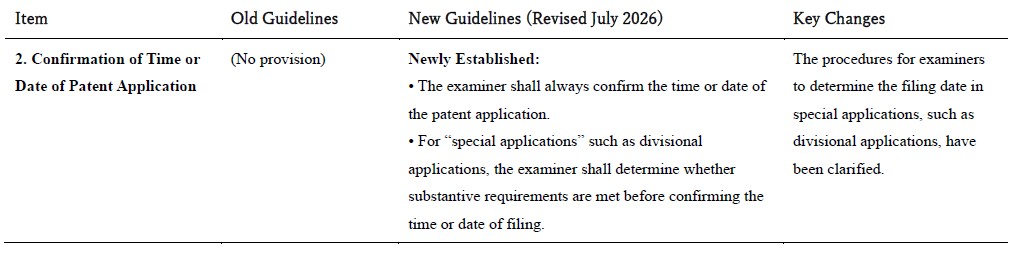
Note: Excerpts and summaries of modified items.
Part III, Chapter 2, Section 2: “Inventive Step”
1. Key Points of Revision
The following three items are the main points of this revision:
(1) Explicit inclusion of comprehensive evaluation based on “differences in degree”
It has been explicitly stated to evaluate the inventive step comprehensively not only based on the presence or absence of factors denying inventive step (such as motivation) and factors supporting it (such as advantageous effects, teaching away factors), but also based on the “differences in the degree of each factor.”
(2) Assessment not overly bound by “explicitly described problems” in cited documents
It has been added that when examiners consider design changes or teaching away factors, they should consider not only problems explicitly stated in cited documents, but also “problems obvious to a person skilled in the art” or “problems that can be easily conceived.”
(3) Revision of the treatment of “teaching away factors” (the expression “lacking eligibility as a cited invention” has been deleted)
Previously, if prior art documents contained descriptions that hindered the invention, it was considered that the invention “lacked eligibility as a cited invention.” This expression has been removed. Going forward, instead of judging the presence or absence of eligibility, the teaching away factor is regarded as a “factor working in favor of affirming inventive step” and is evaluated comprehensively alongside other factors.
2. Comparison Table (Main Changes)
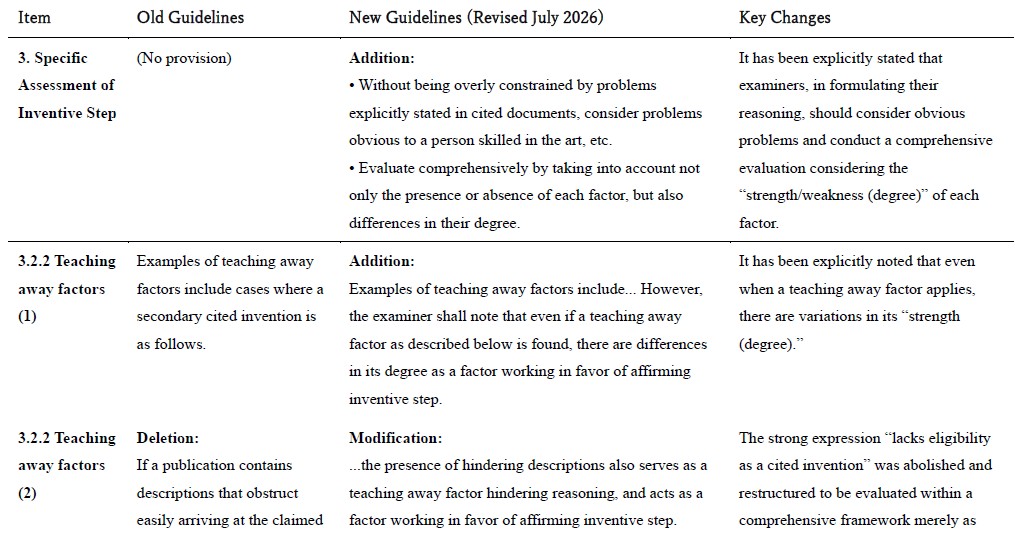

Note: Excerpts and summaries focusing on items with significant practical impact.
Part III, Chapter 3: “Secret Prior Art” (Patent Act Article 29bis)
1. Key Points of Revision
In this revision, the following two points were explicitly stated as standards for examiners when determining whether applicants are identical:
(1) Consideration of Notice of Change of Applicant
It was explicitly stated that if a Notice of Change of Applicant has been filed for the prior application (another application), the applicant at the time of filing the later application shall be determined taking that notice into consideration.
(2) Clarification of the handling of name changes and general succession without notification to the JPO
It was specified in detail that in cases of an applicant’s change of name or general succession (inheritance, merger, company split, etc.), even if notification of change of applicant to the JPO has not been completed, applicants may still be determined to be substantially identical.
2. Comparison Table
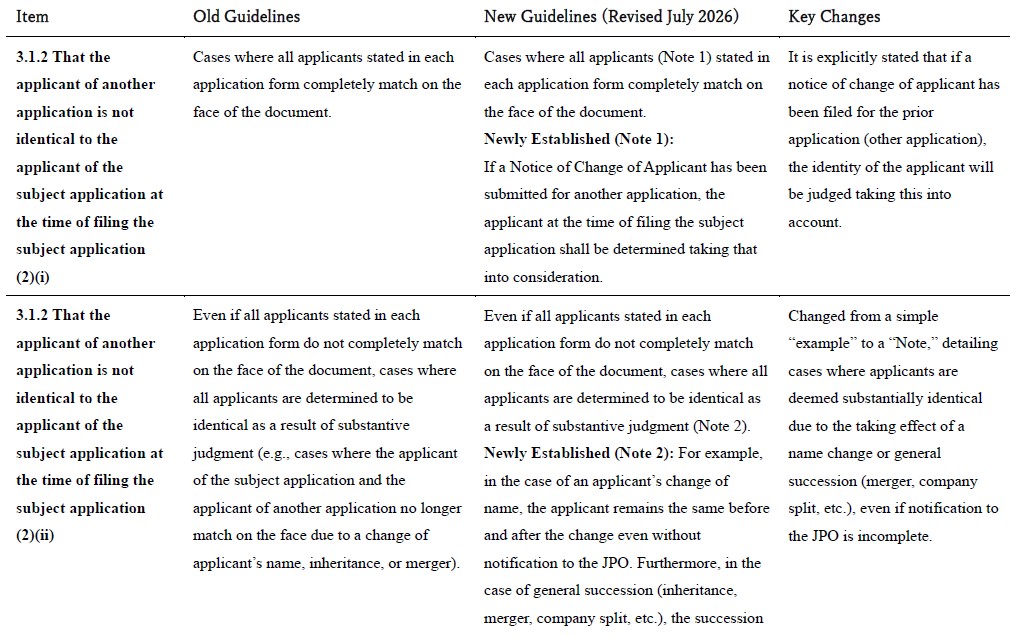

Note: Excerpts and summaries of modified items.
Part III, Chapter 4: “Prior Application” (Patent Act Article 39)
1. Key Points of Revision
In particular, the following changes were made regarding the handling of applications filed on the same date:
(1) Removal of restriction on issuing a decision of rejection based on “other grounds for rejection” against applications without examination requests
Previously, if the other party (same-day application) had not requested examination, even if the subject application had grounds for rejection other than Article 39 (Prior Application), a decision of rejection could not be issued based on those grounds. However, under the new guidelines, the practice has changed to issue a decision of rejection directly if grounds for rejection other than Article 39 are not overcome.
(2) Change allowing an “Order for Consultation” to be issued even for applications without examination requests
Previously, if the other party had not requested examination, examiners notified that “examination cannot proceed” and waited. Under the new guidelines, the practice has changed so that the JPO issues an “Order for Consultation” to both parties even if the other party has not filed a request for examination.
(3) Codification of handling after an “Order for Consultation”
Detailed practical rules have been newly established, such as specifying that after receiving an Order for Consultation, applicants do not necessarily need to submit a notification of consultation results and may overcome the “identity of invention” through amendments or written opinions, and that contradictory assertions by both parties will be deemed as a failure to reach agreement in consultation.
2. Comparison Table
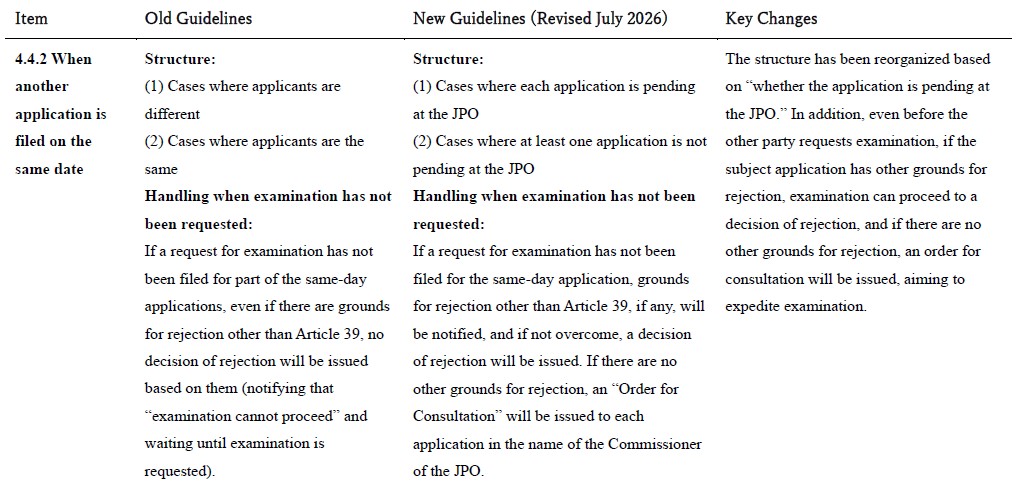
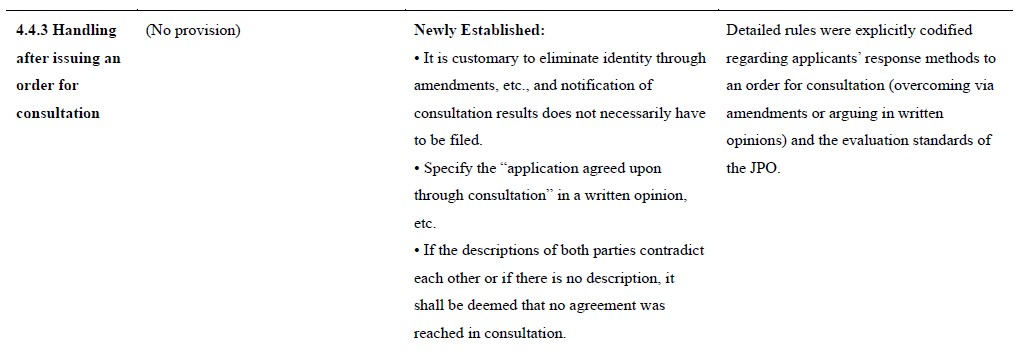
Note: Excerpts and summaries focusing on items with significant practical impact.
Part IV, Chapter 2: “Amendment Adding New Matter”
1. Key Points of Revision
The following are three main points of this revision:
(1) Establishment of the requirement of being “remarkably different as a technical concept”
Simply claiming that “the amendment merely excludes overlap with the cited invention” will not be sufficient to prove that it does not constitute new matter. It has been explicitly stated that the target of exclusion must be one “having a technical concept that is significantly different to the extent that it is completely unimaginable from the time of filing that it would be included in the applicant’s invention.”
(2) Explicit requirement for the applicant’s “burden of explanation”
When the amendment involves a disclaimer in the claims, it is no longer sufficient for the applicant to merely assert in a written opinion, etc., that “the technical concepts are simply different.” The applicant is now required to logically explain, based on the problem to be solved by the invention and common general technical knowledge, “why it is completely unimaginable from the time of filing that it would be included.”
(3) Replacement of specific example (Example 4)
To clearly illustrate the above, the specific example in the guidelines was replaced from “iron plate washing agent” to a case with completely different (completely unimaginable) purposes and technical concepts: the claimed invention “oral administration composition for animals (for anti-mold purposes)” and the cited invention “pesticide composition for killing harmful animals (highly toxic).”
2. Comparison Table
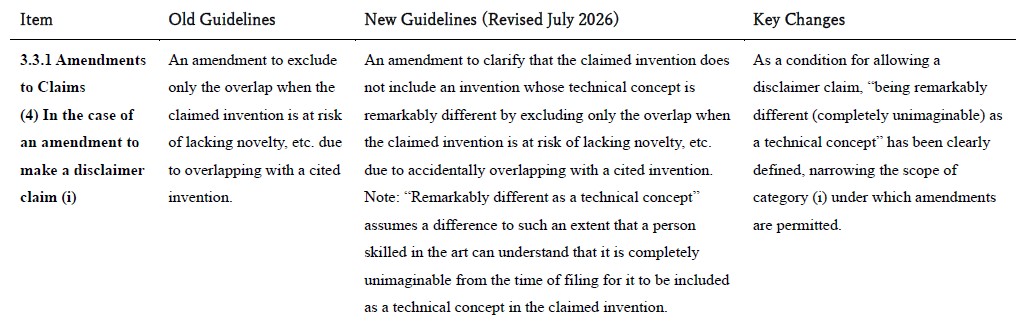
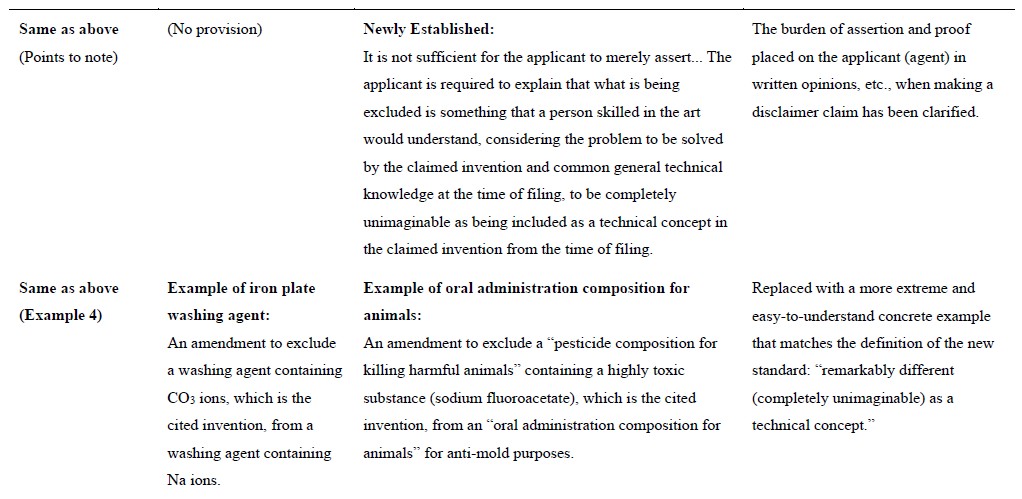
Note: Excerpts and summaries focusing on items with significant practical impact.
Part VII, Chapter 1: “Overview of Foreign Language Written Application System”
1. Key Points of Revision
In this revision, the following points were clearly established as rules:
(1) Explicit reason why amendments and divisions cannot be made before submitting translations
It was logically specified that before translations are submitted, it is a state where “no specification, etc. exists,” and therefore amendments or divisional applications cannot be made.
(2) Clarification of judgment standards for divisional requirements (whether within the scope of the original application)
Regarding the judgment of whether the contents of a divisional application are “within the scope of the original application,” it was explicitly stated that it must be “within the scope described in the foreign language document and within the scope of matters described in the translation (including the scope where correction of mistranslation is permissible).”
(3) Clarification of allowable scope for “Correction of Mistranslation” in divisional applications
When filing a divisional application, an applicant may wish to correct a “mistranslation” that existed in the specification, etc. of the original application immediately prior to division. In this case, it has been explicitly stated that if a “Written Correction of Mistranslation” is submitted in the divisional application and the correction is within the scope permissible in the original application, it will be recognized as a lawful division (within the scope of the specification, etc. immediately prior to division).
2. Comparison Table
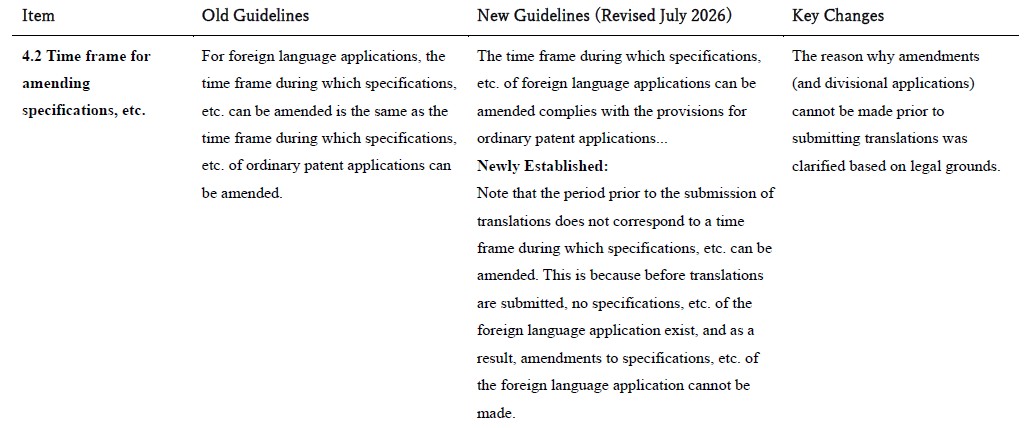
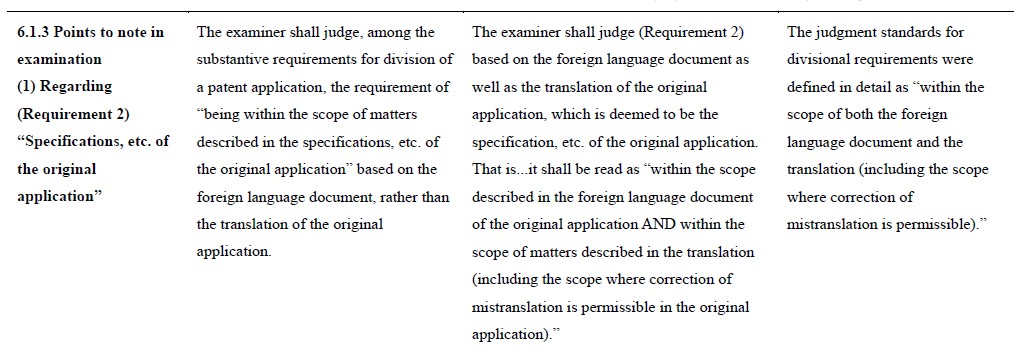
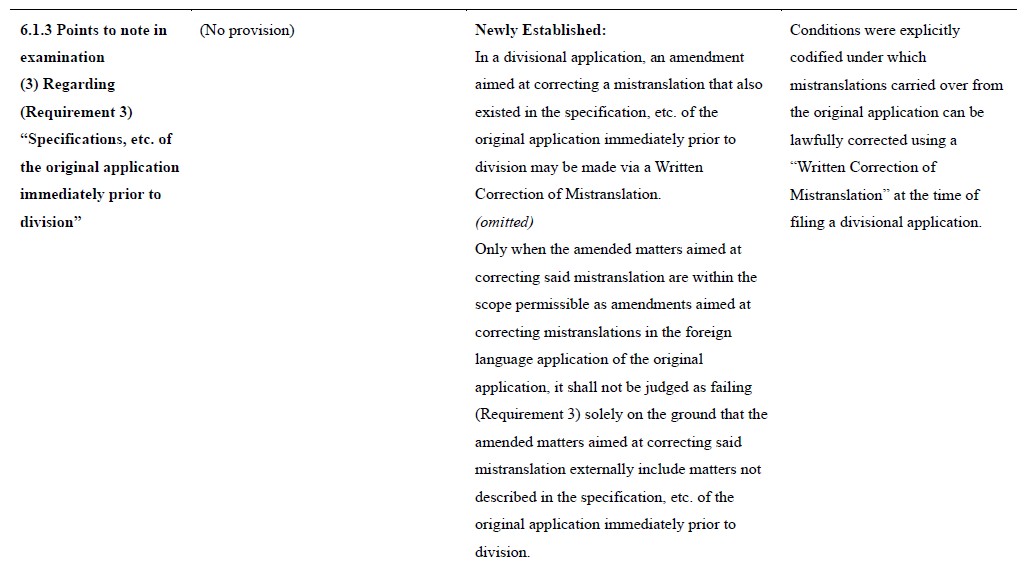
Note: Excerpts and summaries focusing on “Requirements for Division of Patent Applications,” which have a significant practical impact.
Part VII, Chapter 2: “Examination of Foreign Language Written Applications”
1. Key Points of Revision
For foreign language applications, a Japanese “translation” must, in principle, be submitted within 1 year and 4 months from the filing date (priority date). If there are errors in the translation, submitting a “Written Correction of Mistranslation” later to align the text with the original (foreign language document) is permitted.
In this revision, loophole procedures exploiting this mechanism were explicitly prohibited as an “abuse of the system”:
(1) Prohibited procedure
The procedure of “translating and submitting only a tiny fraction of the foreign language document just to make the translation submission deadline, and adding the remaining vast majority of translation later using a ‘Written Correction of Mistranslation’.”
(2) Handling after revision
Such procedures will not be recognized as “corrections of mistranslation” and will be treated the same as ordinary amendments. As a result, they will be subject to rejection as constituting “addition of new matter to translation (adding matters not described in the initial partial translation).”
2. Comparison Table
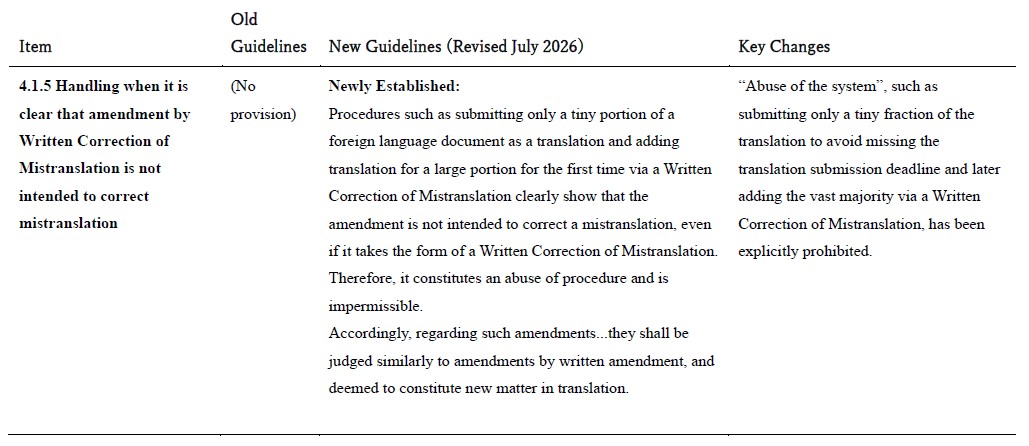
Note: Excerpts and summaries of items newly established in this revision.
Part VIII: “International Patent Application”
1. Key Points of Revision
When filing a divisional or converted application in Japan based on an international patent application (especially those filed in a foreign language), an examination of substantive requirements is conducted to determine whether the content is “within the scope of the application as originally filed.”
In this revision, the judgment methodology for such applications was organized to explicitly refer to and apply mutatis mutandis the provisions of the revised “Foreign Language Written Application System (Part VII, Chapter 1)” above. As a result, it has been made clearer in the guidelines that divisions and conversions originating from PCT applications will also be examined under the same standards as regular foreign language applications (such as handling corrections of mistranslations).
2. Comparison Table
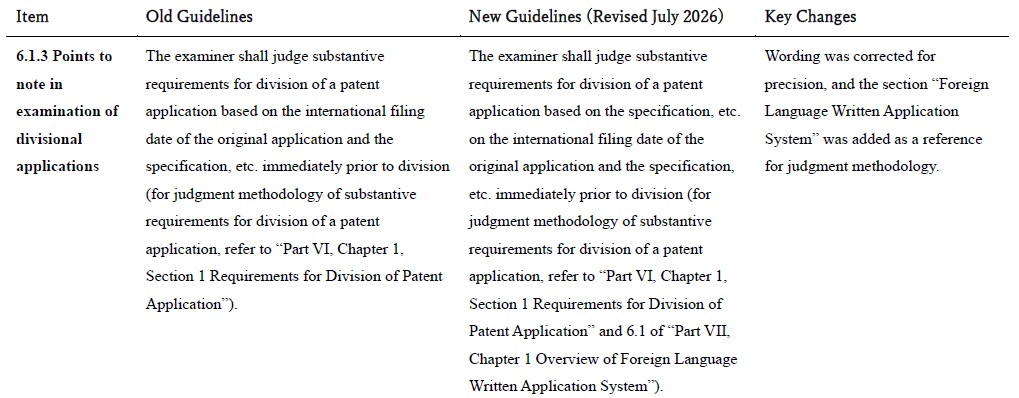
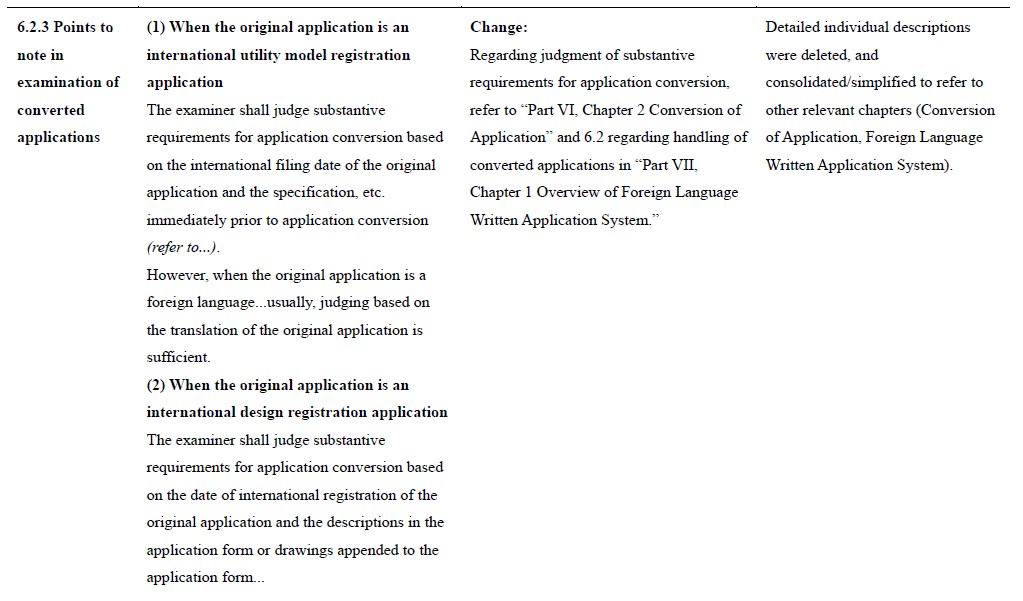
Note: Excerpts from main items where references were added or descriptions reorganized.
Yuuji WADA