
Japanese Patent Case Summary: 2024 (Ne) No. 10012 – Intellectual Property High Court (July 10, 2025)
“Mobile Phone, R-Badge, Receiver”
Overview:
This case pertains to a case in which an assertion of patent infringement, based on a sub-combination invention (the inventions of the respective devices that are combined with respect to an invention of an entire device obtained by combining two or more devices (a combination)), was dismissed by adopting a patent invalidity defense.
▶Summary of Judgement and Link to Full Text (Japanese)
Main Issue:
Whether it can be said that the description “individual information corresponding to the selected one new function”, which is among the matter defining the invention of “transmitting to…the mobile phone a transmission request for ‘individual information corresponding to the selected one new function’”, has defined a configuration/function of the receiver in Corrected Invention 5, which is addressed to “[a] receiver having an RFID interface for transmitting to and receiving from the mobile phone according to claim 4” (note: “selection of a new function” is construed as being performed by the mobile phone in claim 4).
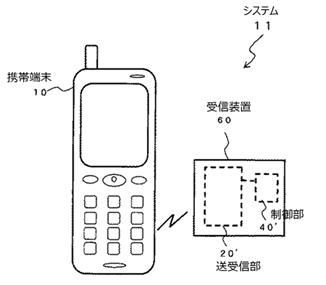
10 Mobile terminal
11 System
20′ Transceiver unit
40′ Control unit
60 Receiver
Summary:
In finding the invention of “the claimed sub-combination” (receiver) in Corrected Invention 5 of the present case, those matters relating to “the other sub-combination” (the mobile phone recited in claim 4) should also be considered, but having considered this in view of its structure, function, shape, composition, effect, properties, characteristics, application and the like (hereinafter, “structure, function and the like”), the matters relating to said other sub-combination are matters that only define said other sub-combination, and if they do not define the structure, function and the like of the claimed sub-combination, it is proper to find, as the gist of Corrected Invention 5, that the matters relating to said other sub-combination are meaningless for defining said claimed sub-combination.
…
Concerning “individual information corresponding to the selected one new function” in Corrected Invention 5 of the present case, …, selecting a new card function on a mobile terminal is described, but selecting a function corresponding to this or the like on a receiver is not described. The specification subsequent to the correction of the present case also merely describes that the receiver makes “a transmission request for individual information corresponding to the selected one new function”, and there is no technological explanation as to confirming correlation with a selection on the mobile terminal, making a selection on a receiver so as to coordinate with a selection on a mobile terminal, or the like, when making the transmission request. Furthermore, even in a case of performing predetermined processing necessary for an individual information system concerning individual information that the receiver receives from the mobile terminal, in the specification for this case the receiver merely determines whether or not this individual information is “the requested individual information”, and there is no indication that it determines whether or not the individual information is individual information that corresponds to a function selected on a mobile terminal.
As such, the “individual information corresponding to the selected one new function” in Corrected Invention 5 of the present case merely defines a configuration, function and the like of a mobile phone, and states that the individual information received by a receiver is defined on the mobile phone; this description cannot be said to define a configuration, function and the like of the receiver. Consequently, the “individual information corresponding to the selected one new function” in Corrected Invention 5 of the present case, which is an invention relating to a “receiver”, should simply be viewed as not technically differing from something that describes “individual information”.
Comments:
In the present case, it was determined that the description concerning “the other sub-combination” in Corrected Invention 5 does not specify the “structure, function and the like of the claimed sub-combination”, and as a result, the inventive step of the invention of the claimed sub-combination was denied, and the patent invalidation defense was accepted.
The plaintiffs (appellants) asserted that “the matters relating to the mobile phone of corrected claim 4 of the present case (being able to select one of the plurality of new functions) are not matters specifying only the device, but can also be said to specify the structure, function and the like of the invention of the ‘receiver’ according to Corrected Invention 5 of the present case (a transmission means for transmitting a transmission request for individual information corresponding to the selected one new function to the mobile phone brought close to the receiver by depressing a read switch provided on the receiver)”; however, this argument was not adopted.
The finding on Corrected Invention 5 of the present case is in line with the thinking presented in the section entitled “4. Expression Specifying the Invention of Sub-Combination by Elements of ‘Another Sub-Combination’” in “Part III, Chapter 2, Section 4 Claims Including Specific Expressions” of Examination Guidelines for Patent and Utility Model in Japan, and appears appropriate.
In considering such matters as the likelihood of the implementing actors of the inventions of each sub-combination differing from each other, and the technical scope of the sub-combination inventions being conceivably broader than the invention of the entire device (combination), reciting a sub-combination invention in the claims can be considered an effective strategy; however, it is necessary to bear in mind that even if the invention of the entire device (combination) is recognized as having novelty and inventive step, the inventions of sub-combinations thereof might not be recognized as having novelty and inventive step. In borderline instances where inventive step might be recognized solely for the configuration of a sub-combination, the enforcement of rights based on indirect infringement also becomes a possibility, and it is considered preferable that the invention of the entire device (combination) is also recited in the claims.
Mitsuaki KOBIKI