
Japanese Patent Case Summary: 2024 (Wa) No. 70064 – Tokyo District Court (December 17, 2025)
“Aerosol for Mosquito Control and Method of Mosquito Control”
Overview:
This case concerns a patent relating to an aerosol for mosquito control. In an action for patent infringement seeking an injunction and other relief, the issues in dispute were whether the defendant’s article fell within the technical scope of the patented invention, and whether the defense of the patent of this case being invalid was established. The court dismissed the plaintiff’s claim, stating that the patent right of this case is unenforceable, that the patented invention does not meet the clarity requirements and that it should be invalidated through patent invalidation proceedings.
▶Summary of Judgment and Link to Full Text (Japanese)
Main Issue:
Whether the matter defining the invention of “is sprayed as adhesive particles at least some of which adhere to exposed surfaces where mosquitoes alight within the treatment space” is so unclear as to cause unforeseen disadvantage to third parties (i.e., whether there is a ground for invalidation under Patent Act Article 36(6)(ii)).
Summary:
As for “adhesive particles,” it can be understood that they are agent particles formed when the aerosol concentrate is sprayed and that they adhere to exposed surfaces where mosquitoes alight within the treatment space; however, the meaning of “adhesive” is not clear from the claim language.
According to the specification and the above claim language, “adhesive particles” can be understood to mean agent particles formed by spraying the aerosol concentrate into the treatment space, which adhere to exposed surfaces in the treatment space, remain adhered over time, and exterminate/control mosquitoes that alight on the exposed surfaces.
For particles to be “particles that remain adhered over time and exterminate/control mosquitoes that alight on exposed surfaces,” mere adhesion to the exposed surfaces is not sufficient; therefore, the degree of adhesion necessary to be able to say they “remain adhered over time” needs to be clear.
The specification describes a preferred amount of adhesion for the “adhesive particles,” but it contains no description whatsoever of test methods, measurement methods or the like for confirming the adhesion amount, nor is there any indication that any particular test or measurement methods were common general knowledge as of the priority date. Therefore, from the above description, one cannot specifically ascertain the degree of adhesion required to be able to say that the particles “remain adhered over time.”
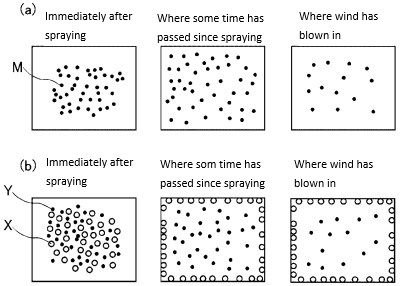
As examples and comparative examples, the specification describes (1) a test of the airborne residual rate, calculated by analyzing the airborne concentration of the pest-control component collected two hours after spraying, and (2) a test of control efficacy in which, at the time points immediately after spraying and 10, 14, and 20 hours thereafter, mosquitoes are released and the time until 50% are knocked down (KT50 value) is measured.
Ultimately, from tests (1) and (2) above, it is unclear whether the KT50 values at 10 hours and thereafter (test (2)) are due to the agent particles adhering to exposed surfaces controlling mosquitoes resting on those surfaces, or due to the pest-control component contained in the particles adhering to exposed surfaces volatilizing and controlling mosquitoes in the air. Thus, tests (1) and (2) cannot be said to demonstrate that the agent particles remained adhered over time and controlled mosquitoes that alight on exposed surfaces.
In addition, the specification contains no concrete description of the degree of adhesion required to be able to say that the particles “remain adhered over time,” and there is also no description of test methods, measurement methods or the like for confirming this. Accordingly, one cannot understand the meaning and substance of the “adhesive particles” as defined by the invention based on the specification’s disclosures.
In light of the foregoing, the claim language must be deemed so unclear as to cause unforeseen detriment to third parties, since a person skilled in the art would not be able to understand the limitation “is sprayed as adhesive particles at least some of which adhere to exposed surfaces where mosquitoes alight within the treatment space” based on the specification and the common general knowledge as of the priority date.
Comments:
This judgment adopts the judgment criterion for the clarity requirement that has been established by numerous prior decisions (that it should be assessed from the standpoint of whether the claim language is so unclear as to cause unforeseen detriment to third parties), and with respect to the matter defining the invention expressed in terms of function or properties, interprets “adhesive particles” based on the specification and the claim language, and holds that to qualify as “particles that remain adhered over time and exterminate/control mosquitoes that alight on exposed surfaces,” mere adhesion to exposed surfaces is not sufficient; the degree of adhesion necessary to be able to say they “remain adhered over time” must be clear. This point is noteworthy.
The court pointed out that although the specification describes a preferred adhesion amount for the “adhesive particles,” it contains no description of test methods, measurement methods or the like to confirm the adhesion amount; that it is not apparent that any specific test or measurement methods were common general knowledge as of the priority date; and that even after examining two tests using the examples and comparative examples, there is no concrete description of the degree of adhesion or of methods to confirm it. The court therefore concluded that one cannot understand the meaning and substance of the “adhesive particles” as defined by the invention.
Even if there is no direct recitation of “remain adhered over time” as the matter defining the invention, the court determined that because the meaning and substance of the matter defining the invention expressed in terms of function or properties in the claims is unclear, the technical scope of the invention cannot be ascertained, and after reasonably taking into account the specification’s disclosures, concluded that the extent of the matter defining the invention has not been made clear.
This judgment suggests that even if the technical concept of the invention (adhering agent particles to exposed surfaces in the treatment space to control mosquitoes) is clear, it is necessary for the specification to include descriptions of results that clarify the degree at issue and to include test and measurement methods when using the matters defining the invention expressed in terms of function or properties, which tend to render the technical scope unclear.
Satoki SERA