
Japanese Patent Case Summary: 2025 (Gyo-Ke) No. 10056 – Intellectual Property High Court (December 23, 2025)
“Women’s Garment”
Overview:
This case relates to a court decision upholding a JPO trial decision that rejected a petition for invalidation of the patent at issue, where the petitioner alleged grounds including lack of inventive step against the invention of claim 1 (Present Invention 1), but the court found that a person skilled in the art would not have been able to readily make Present Invention 1 based on the invention disclosed in the publication of Plaintiff’s Exhibit 1 (the “Plaintiff’s Exhibit 1 Invention”), among other things.
▶Summary of Judgment and Link to Full Text (Japanese)
Claim 1
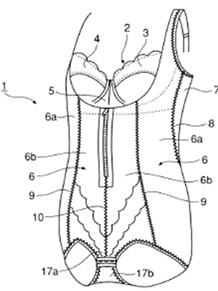
The wording of claim 1 according to the subject patent is as follows (the drawing is FIG. 1 that was appended to the application form for the subject patent):
“A women’s garment that covers at least a woman’s bust portion, the women’s garment comprising: a cup member that covers at least the woman’s bust portion; left and right front-body members that are disposed on a surface side of the cup member in a state separated from the cup member, and that are provided from respective left and right side portions of the bust portion so as to cover side portions of the bust and extend toward a central portion of a lower part of the bust; and a plurality of connecting members that connect the left and right front-body members to each other in the vicinity of the central portion of the lower part of the bust and are provided so that a connection width between the left and right front-body members is adjustable.”
Main Issue:
Whether the JPO trial decision’s determination on inventive step was appropriate.
Summary:
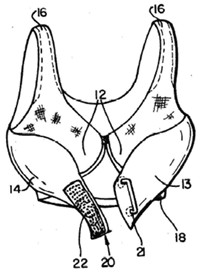
The court upheld the JPO trial decision that affirmed an inventive step in Present Invention 1 by finding Plaintiff’s Exhibit 1 Invention (the drawing is FIG. 2 in Plaintiff’s Exhibit 1) as well as the difference between Present Invention 1 and Plaintiff’s Exhibit 1 Invention, respectively, as follows, thus determining ease of conceptualization of that difference as summarized below.
Plaintiff’s Exhibit 1 Invention
“A women’s sports garment that covers a woman’s breasts, comprising: breast engaging pockets 12 that cover the woman’s breasts; two breast supporting flaps 13 and 14 that are independently displaceable from the breast engaging pockets 12, overfit the breast engaging pockets 12, and are provided from respective left and right side portions of the breasts so as to cover side portions of the breasts and extend toward a central portion of the breasts; and a fastener means 22 that connects the two breast supporting flaps 13 and 14 in the vicinity of the central portion of the breasts and is provided so that a connection width between the two breast supporting flaps 13 and 14 is adjustable.”
Difference
With respect to “left and right front body members that are disposed on a surface side of the cup member in a state separated from the cup member, and that are provided from respective left and right side portions of the bust portion so as to cover side portions of the bust and extend toward a central portion of the bust,” and “a plurality of connecting members that connect the left and right front body members to each other in the vicinity of the central portion of the bust and are provided so that a connection width between the left and right front body members is adjustable,” Present Invention 1 differs in that the left and right front body members are provided so as to extend toward a central portion of a “lower part of the bust,” and the connecting members connect the left and right front body members to each other in the vicinity of the central portion of the “lower part of the bust,” whereas, in the Plaintiff’s Exhibit 1 Invention, the breast supporting flaps 13 and 14 overfit the breast engaging pockets 12, and there is no specification that the positional relationship of the fastener means 22 with respect to the bust is at the “lower part of the bust.”
Ease of Conceptualization of the Difference
“…The technical significance of Invention 1’s feature of ‘connecting the left and right front body members to each other in the vicinity of the central portion of the lower part of the bust, and making the connection width between the left and right front body members adjustable by a plurality of connecting members’ lies in that, by connecting the left and right front body members to each other in the vicinity of the central portion of the lower part of the bust and adjusting the connection width between the left and right front body members, it becomes possible to draw the left and right busts toward each other and also lift the left and right busts upward from below, thereby making it possible to provide, at low cost, a women’s garment that can accommodate variations in the size and shape of a woman’s bust, or correction functions such as bust enhancement.”
“On the other hand, in the Plaintiff’s Exhibit 1 Invention, the breast supporting flaps 13 and 14 are arranged so as to overfit the breast engaging pockets 12, and the breast supporting flaps 13 and 14 cover and compress the entire breasts; the technical significance of connecting the breast supporting flaps 13 and 14 by the fastener means 22 lies in thereby providing inward pressure on the breasts and preventing excessive movement of the breasts of women engaged in physical activity, and it cannot be said that the above configuration is intended to accommodate variations in the size or shape of a woman’s bust, or correction functions such as bust enhancement.”
“Accordingly, the configuration of the Plaintiff’s Exhibit 1 Invention in which the breast supporting flaps 13 and 14 overfit the breast engaging pockets 12 is recognized as being for solving the problem addressed by the Plaintiff’s Exhibit 1 Invention, which differs from the problem addressed by Invention 1, and it cannot be said that, at the time of filing of Invention 1, there was any motivation to change the configuration so that the tightening position of the breast supporting flaps 13 and 14 would be at the lower part of the bust and so that the lower part of the bust would be covered. Moreover, if the configuration were changed in this manner, the range in which the breast supporting flaps 13 and 14 compress the breasts and provide inward pressure thereto would be reduced, making it impossible to solve the problem of preventing excessive movement of the breasts of women engaged in physical activity; therefore, it can be said that there is a factor discouraging the above change.”
Comments:
The court held that it could not be said that, in the Plaintiff’s Exhibit 1 Invention, there was any motivation to modify it to adopt the configuration relating to the distinguishing feature, and further held that such a modification would prevent the Plaintiff’s Exhibit 1 Invention from solving its problem, and therefore that such a modification involves a disincentive factor.
With respect to disincentive factors, the JPO Examination Guidelines (Part III, Chapter 2, Section 2, Inventive Step, 3.2.2) explain that “the existence of circumstances that discourage applying the secondary cited invention to the primary cited invention functions as an element that works in the direction of affirming inventive step, as a factor (disincentive factor) that impedes the reasoning,” and give, as one example of a disincentive factor, “(i) a secondary cited invention which, if applied to the primary cited invention, would cause the primary cited invention to run counter to its purpose.” These directions can be said to generally accord with the logic by which the present judgment found a disincentive factor.
This judgment is useful in practice in that it determines whether the distinguishing feature would have been easily conceivable after carefully finding the facts regarding the problem addressed by the invention at issue (Invention 1) and its means for solving the problem, the problem addressed by the primary cited invention (the Plaintiff’s Exhibit 1 Invention) and its means for solving the problem, and the technical significance of the respective configurations relating to the distinguishing feature between the invention at issue and the primary cited invention.
Yasuhiro SUTO