
Japanese Patent Case Summary: 2025 (Gyo-Ke) No. 10075 – Intellectual Property High Court (May 13, 2026)
“COMPOSITIONS COMPRISING 2,3-DICHLORO-1,1,1-TRIFLUOROPROPANE, 2-CHLORO-1,1,1-TRIFLUOROPROPENE, 2-CHLORO-1,1,1,2-TETRAFLUOROPROPANE OR 2,3,3,3-TETRAFLUOROPROPENE”
Overview:
The Intellectual Property High Court maintained the Appeal Board decision which rejected the novelty of Present Invention 1 (a specific composition) relating to the divisional application in view of the publication of the base application (Reference 1) as prior art, and also found that Present Invention 1 failed to satisfy the support requirement, on the premise that the divisional application was unlawful.
▶ Summary of Judgment and Link to Full Text (Japanese)
Main Issue:
Legality of the divisional application (Article 44(1) of the Patent Act: Whether the divisional application falls within the scope of matters described in the specification, etc. of the base application as originally filed)
Present Invention 1
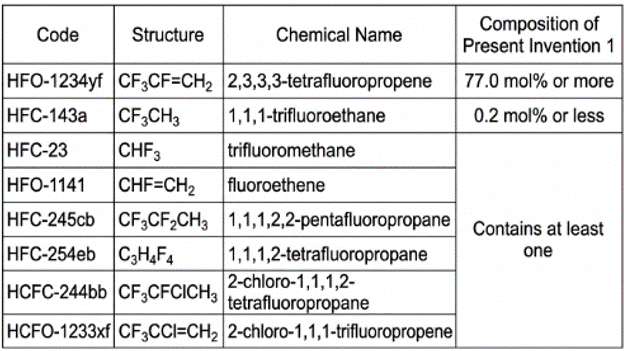
Claim 1 of the present application reads as follows; the compounds constituting the invention according to claim 1 (Present Invention 1) are shown in the separate Table.
“A composition comprising:
77.0 mol% or more of HFO-1234yf;
0.2 mol% or less of HFC-143a; and
at least one additional compound selected from the group consisting of HFC-23, HFO-1141, HFC-245cb, HFC-254eb, HCFC-244bb, and HCFO-1233xf.”
Table:
Summary of Judgement:
Regarding the legality of the divisional application, the Court dismissed the plaintiff’s arguments concerning the above issue, judging as outlined below:
“When an applicant for patent files a divisional application (Article 44(1) of the Patent Act), the application is deemed to have been filed at the time of filing of the base application (the main clause of Paragraph 2 of the same Article). In light of this, it is understood that the matters described in the specification, claims, and drawings of the divisional application must fall within the scope of the matters described in the specification, claims, and drawings of the base application as originally filed”.
“The specification, etc. of the base application, … does not include any explicit description regarding the composition of Present Invention 1, nor is there any description or suggestion regarding the technical significance of setting the respective contents of ‘HFO-1234yf’ and ‘HFC-143a’ to specific proportions, or causing the composition to comprise compounds other than ‘HFO-1234yf’. Accordingly, the technical matters derived from the specification, etc. of the base application is merely the possibility of specific additional compounds that may be present when preparing compounds such as HFO-1234yf which are useful as heat transfer compositions with a low global warming potential. Therefore, specifying a composition having a combination different from that described in the specification, etc. of the base application introduces new technical matter.”
“Example 15 … of the specification, etc. of the base application merely discloses compositions comprising: ‘77.0 mol.% HFO-1234yf,’ ‘85.0 mol.% HFO-1234yf’ or ‘82.5 mol.% HFO-1234yf;’ ‘0.2 mol.% or less HFC-143a;’ and ‘additional compounds.’ It does not disclose compositions comprising at least ‘more than 85.0 mol.% HFO-1234yf,’ ‘0.2 mol.% or less HFC-143a,’ and ‘additional compounds’ among the compound combinations of Present Invention 1.”
“The plaintiff also argues that since a person skilled in the art would have easily recognized that the efficiency of conversion to HFO-1234yf could be increased by using a catalyst and adjusting the temperature, and that there is no difficulty in separating and recovering HFO-1234yf from the product mixture using distillation, the specification, etc. of the base application discloses a composition containing more than 85.0 mol.% HFO-1234yf. However, … even if such separation and recovery were possible for the skilled person, … the composition of the Present Invention 1 is not considered to be disclosed in the specification, etc. of the base application.”
“Based on the above, Present Invention 1 does not fall within the scope of the matters described in the specification, etc. of the base application, and the present application is not considered to have been lawfully filed as a divisional application based on the base application.”
Comments:
The present case focuses on whether “introduction of new technical matter” is found in an application resulting from successive divisions, in which specific numerical ranges or combinations of compounds were extracted from example data in the base application for use as features defining the present invention. Regarding the legality of the division, the Court ruled that it was unlawful because the technical significance of the combinations and numerical ranges was neither described nor suggested in the base application, and also denied the novelty of the present invention on the grounds that compositions within the scope of the present invention have been disclosed in the examples of the base application.
Regarding the division of patent applications, the Patent Act provides that “an applicant seeking a patent may extract one or more new patent applications from a part of a patent application comprising two or more inventions” (Article 44, Paragraph 1); however, there are no specific provisions for determining whether the base application “comprises” the invention(s). In this regard, Tokyo District Court ruled on April 23, 2004 (2003 (Wa) No. 9215) that the substantive requirements for a division are identical to those for an amendment (i). Furthermore, the JPO Examination Guidelines detail that the same criteria that apply to the amendment requirements also apply in determining whether matters described in the specification, etc. of a divisional application fall within the scope of matters described in the specification, etc. of the base application as originally filed (ii).
The determination of whether an amendment constitutes the addition of new matter is made based on whether the amendment “introduces new technical matter” in relation to the matters described in the original specification, etc. (IP High Court Decision of May 30, 2008, 2006 (Gyo-Ke) No. 10563: Grand Panel Decision on Solder Resist). Although it naturally depends on the findings of each case, an amendment may be determined as not introducing any new technical matter even when no such explicit description is found in the original specification, etc. (see, for example, IP High Court Decision of January 28, 2010, 2009 (Gyo-Ke) No. 10175, and IP High Court Decision of July 22, 2020, 2019 (Gyo-Ke) No. 10046, though concerning the relationship with the original specification, etc. of the parent application). In that sense, this judgment might appear to be a little too hard on the plaintiff.
(i) “A divisional application is deemed to have been filed at the time of the base application (Paragraph 2 of the same Article), and determinations regarding novelty, inventive step, etc. are based on the filing date of the patent application upon which the divisional application is based. Since division of an application (Article 17 of the Patent Act) has a function similar to an amendment, the scope within which a divisional application is allowed should also be understood as being limited to the scope within which amendments to the base application can be made (allowing a division of an application even when the requirements for amendment are not met would be unreasonable, as it would effectively allow evasion of amendment requirements through divisional procedures).”
(ii) “Assuming that the specification, etc. of the divisional application corresponds to an amended specification, etc. in relation to the ‘specification, etc. of the base application as originally filed’, judgment is made based on whether the amendment introduces new matter in light of the ‘specification, etc. of the base application as originally filed.'” (Part VI, Chapter 1, Section 1: Requirements for Division of Patent Application, 3.2)
Yasuhiro SUTO