
Japanese Patent Case Summary: 2024 (Gyo-ke) No. 10099 – Intellectual Property High Court (November 13, 2025)
“Information Network System Including Massage Machine”
Overview:
A case in which an opposition decision that, after allowing a correction, revoked the patent with respect to the inventions according to claims 1 and 4 to 9 was upheld.
▶Summary of Judgment and Link to Full Text (Japanese)
Main Issues Introduced Here:
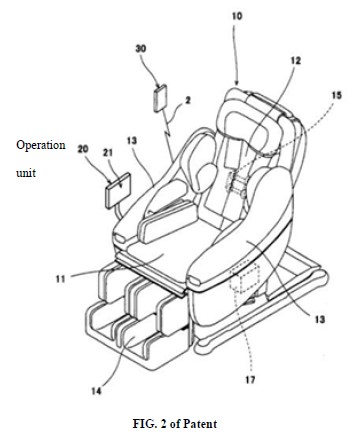
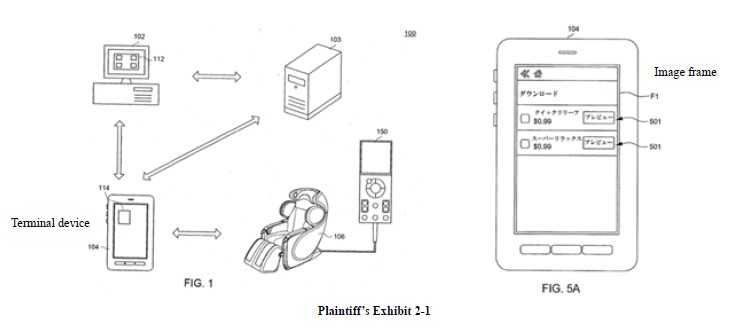
(1) Whether the decision correctly found that the “terminal device 104” of the Plaintiff’s Exhibit 2-1 Invention and the “operation unit” of Corrected Invention 1 coincide in that both are “a terminal device installed in a massage machine.”
(2) Whether the decision correctly found that the “image frame F1” of the Plaintiff’s Exhibit 2-1 Invention corresponds to the “new arrival notification portion” of Corrected Invention 1.
Court Determinations:
(1) The Plaintiff argues that the “terminal device 104” of the Plaintiff’s Exhibit 2-1 Invention is an “external device” of the massage apparatus 106, and thus does not correspond to “installed in a massage machine” in Corrected Invention 1. Therefore, a point of agreement has been incorrectly identified, and a point of difference has been overlooked.
However, “備え付ける” [sonaetsukeru] means “to place something at a certain location so that it can be used; to provide/install” (Defendant’s Exhibit 1, Kōjien, 6th ed.), and is not understood to necessarily mean a state in which items are not physically separated. The “terminal device 104” of the Plaintiff’s Exhibit 2-1 Invention is, from the standpoint of the massage apparatus, an “external device” (para. 0004, claim 1), but it connects to the massage apparatus and, together with the massage apparatus, constitutes a system that provides massage-related services (para. 0008, claim 12), and it is stated that it can include a smartphone, a tablet-type computer, and the like (para. 0018). That is, even if the “terminal device 104” of the Plaintiff’s Exhibit 2-1 Invention is physically separate from the massage machine (an external device), functionally it is to be understood as a terminal device that can be regarded as being “installed” for the massage apparatus.
In light of these points, there is no error in the decision’s determination that the “terminal device 104” of the Plaintiff’s Exhibit 2-1 Invention and the “operation unit” of Corrected Invention 1 coincide in that both are “a terminal device installed in a massage machine.”
(2) The Plaintiff argues that, in the Plaintiff’s Exhibit 2-1 Invention, the image frame F1 does not have the function of “telling a person that something has newly arrived or has just arrived so that the person knows it,” and therefore cannot be said to be a new arrival notification portion, and that a point of agreement has been misidentified and a difference has been overlooked.
Upon examination, according to the present specification, the massage machine 10 displays received new information on the new arrival notification portion 22 to inform the person receiving treatment that there is new information, and the person receiving treatment can, when using the massage machine 10, confirm via the new arrival notification portion 22 that new information has arrived (para. 0038). In FIG. 5, which shows an example of new arrival notification displayed on the information notification portion 23 (displaying multiple new course items on a new arrival screen), the screen for new information displays multiple items relating to “new treatment courses.” Such notification of new information by the new arrival notification portion of Corrected Invention 1 cannot necessarily be said to notify a person that something has “just arrived”; it includes notifying that there is a new treatment course that has not been introduced into the massage machine.
On the other hand, in the Plaintiff’s Exhibit 2-1 Invention, a notification regarding the release of a new massage program sent from the server computer 103 is notified to the terminal device 104, and the image frame F1 of the notified terminal device 104 displays a list of a plurality of massage programs 501 available for purchase. Therefore, the programs enumerated in the image frame F1 of the Plaintiff’s Exhibit 2-1 Invention are programs of new treatment courses that have not been introduced into the massage machine, and the image frame F1 should be regarded as corresponding to a new arrival notification portion that notifies that these exist.
Comments:
With respect to either of the two issues above, it appears that the Plaintiff (patentee) predicated its arguments on each term of Corrected Invention 1 having the meaning it intended, and on that premise argued that the configuration of Corrected Invention 1 as to each issue differs from the configuration of the Plaintiff’s Exhibit 2-1 Invention.
However, the Court held that the terms of Corrected Invention 1 cannot be construed as narrowly as the Plaintiff contends, rejected the Plaintiff’s arguments, and supported the findings of the opposition decision.
Although the Court’s interpretations of the above terms may seem somewhat harsh on the Plaintiff, it would appear that patentees and patent applicants are being required to use clear wording in the claims that leaves no room to be interpreted as encompassing the configuration of the cited invention.
Mitsuaki KOBIKI